
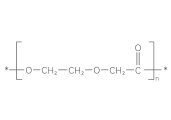
PPDO is a biodegradable material. In the natural environment or within organisms, hydrolysis gradually breaks down the ester bonds in its backbone, ultimately degrading it into dioxanone monomer and its derivatives. These degradation products participate in biological metabolism, are environmentally friendly, and do not cause long-term pollution. Its degradation rate is relatively slow, and can be controlled by adjusting factors such as molecular weight and crystallinity to meet the needs of different application scenarios.

In general chemical environments, PPDO exhibits good chemical stability and can withstand the erosion of common acidic and alkaline environments and chemical reagents. However, under extreme conditions such as strong acid or alkali or high temperature and humidity, the hydrolysis rate of its ester bond will accelerate, leading to accelerated degradation of the material.
Sutures made from PPDO offer excellent flexibility and knot stability, adapting to tissue movement during wound healing without breaking. Furthermore, due to its biodegradability, the sutures gradually degrade and are absorbed by the body as the wound heals, eliminating the need for suture removal. The smooth monofilament structure and high tensile strength make it suitable for soft tissue suturing (such as vascular and nerve repair). Once degraded, they do not need to be removed, reducing patient pain and the risk of infection. They are commonly used for delicate suturing in gynecology, obstetrics, and plastic surgery.
PPDO can be formulated into microspheres and nanoparticles to encapsulate drugs for sustained release. Its relatively slow degradation rate enables sustained drug release over an extended period, maintaining effective drug concentrations and enhancing drug efficacy. For example, in the treatment of chronic diseases such as cardiovascular disease and diabetes, PPDO drug-release carriers can provide a long-term, stable drug supply.
PPDO's flexibility and biocompatibility make it an ideal material for tissue engineering scaffolds. It provides a suitable microenvironment for cell adhesion, proliferation, and differentiation, promoting tissue repair and regeneration. In cartilage tissue engineering, PPDO scaffolds can mimic the elasticity and flexibility of cartilage, facilitating the growth of chondrocytes and the reconstruction of cartilage tissue.
As implants such as bone plates, screws, and anchors, they provide temporary support and gradually degrade as the bone heals.
PPDO's excellent flexibility and chemical stability make it suitable for food packaging. It can be made into films, bags, and other packaging forms, effectively protecting food from environmental influences and extending its shelf life. Furthermore, its biodegradability allows food packaging to naturally decompose after use, reducing environmental pollution and aligning with the trend toward eco-friendly packaging.
In electronic product packaging, PPDO's flexibility provides excellent cushioning and protection, preventing damage from impact and vibration during transportation and storage. Furthermore, its biodegradability helps address the challenge of electronic waste disposal and reduce environmental impact.
PPDO fiber exhibits excellent elasticity and flexibility and can be blended with other fibers to create stretchable textiles. These textiles are widely used in sportswear, underwear, and other fields, providing a comfortable wearing experience while also being biodegradable and environmentally friendly.
PPDO can be used to create biodegradable nonwoven fabrics, which have promising applications in healthcare, filtration materials, and other fields. For example, in the healthcare field, it can be used to manufacture disposable items such as surgical gowns and masks, which naturally degrade after use, reducing medical waste.
| 31621-87-1 | Project Name | Method | Limit |
|---|---|---|---|
Polydioxanone、 Poly(p-dioxanone) | Traits | Visual | Milky white solid |
| Melting point | DSC | 100~120℃ | |
| Melt Flow Rate (MFR) | Melt flow rate meter | <12.0 g/min | |
| Moisture | Karl Fischer-Coulomb method | ≤100ppm | |
| Monomer residue | Gas chromatography | ≤1% |
| 31621-87-1 | Project Name | Method | Limit |
|---|---|---|---|
Polydioxanone、 Poly(p-dioxanone) | Tin content | ICP-OES | ≤30ppm |
| Heavy metals (expressed as Pb) | ICP-OES | <5ppm | |
| Total residual solvent (toluene) | Gas chromatography | <5ppm | |
| Intrinsic viscosity | Capillary viscometer | < 3.0 dL/g (HFIP,25℃,c=0.1g/dl) | |