
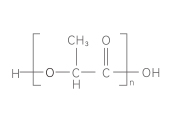
PDLLA is a biodegradable material. In the natural environment or within the body, it gradually degrades into D-lactic acid and L-lactic acid through hydrolysis of ester bonds. The final metabolites are carbon dioxide and water, making it environmentally friendly. Compared to PLLA, its degradation rate is relatively rapid, and the degradation rate can be controlled by adjusting factors such as the polymer's molecular weight, composition, and material morphology. The degradation time can range from several months to over a year.

In general chemical environments, PDLLA has a certain degree of chemical stability and can withstand some common chemical reagents and organic solvents. However, in the presence of strong acids, strong bases, or high temperatures and humidity, the hydrolysis rate of its ester bond will be significantly accelerated, leading to accelerated material degradation.
PDLLA is often formulated into microspheres, nanoparticles, and other dosage forms as drug carriers. Its excellent biocompatibility and tunable degradation rate enable slow, sustained drug release. By adjusting the composition and structure of PDLLA, the rate and timing of drug release can be precisely controlled, improving drug efficacy and minimizing toxic side effects. For example, in cancer treatment, encapsulating chemotherapy drugs in PDLLA microspheres allows for targeted delivery and sustained release at the tumor site, enhancing tumor cell killing. In vaccine delivery, PDLLA nanoparticles can act as adjuvants to enhance immune responses.
In tissue engineering, PDLLA can be fabricated into scaffolds with three-dimensional porous structures. These scaffolds provide a suitable microenvironment for cell adhesion, proliferation, and differentiation, promoting tissue repair and regeneration. Its rapid degradation makes it particularly suitable for tissue repair applications requiring rapid degradation, such as soft tissue repair. For example, in skin tissue engineering, PDLLA scaffolds can promote the growth and migration of skin cells, accelerating wound healing.
PDLLA can be used to manufacture a variety of absorbable medical devices, such as sutures, staples, and bone fixation devices. For example, while sutures may not be as strong as those made from materials like poly(glycolide) (PGA), PDLLA sutures offer excellent flexibility and biodegradability, making them suitable for surgical applications where strength is less critical. They also degrade and absorb over time, eliminating the need for suture removal.
PDLLA's transparency, barrier properties, and biodegradability make it an ideal material for food packaging. It can be made into films, containers, and other packaging forms, effectively blocking the ingress of oxygen, moisture, and odors, extending the shelf life of food. Furthermore, it degrades naturally after use, reducing environmental pollution and meeting environmental protection requirements. For example, it is suitable for packaging fresh fruits, vegetables, and baked goods.
PDLLA can be used to manufacture disposable tableware, shopping bags, plastic wrap, and other packaging products. These products gradually decompose in the natural environment after use, reducing the white pollution caused by traditional plastic packaging. Its excellent processing properties allow it to meet packaging needs of various shapes and sizes.
Agricultural film made from PDLLA offers excellent thermal insulation, moisture retention, and light transmission properties, promoting crop growth. Furthermore, after use, the film naturally degrades in the soil, eliminating the damage to soil structure and the environment caused by traditional film residue. Compared to traditional film, PDLLA film requires no manual recycling after use, reducing labor costs and environmental pollution.
PDLLA can be used as a carrier for slow-release fertilizers, encapsulating fertilizers for a slow release. By controlling the degradation rate of PDLLA, nutrients can be continuously supplied throughout the crop's growth cycle, improving fertilizer utilization and reducing fertilizer waste and environmental pollution.
| 26023-30-3 | Project Name | Method | Limit |
|---|---|---|---|
Poly(D,L-lactide)、 D,L-polylactide | Traits | Visual | White to yellow solid |
| Moisture | Karl Fischer-Coulomb method | <0.5% | |
| Monomer residue | Gas chromatography | DL-LA≤0.1% | |
| Tin content | ICP-OES | ≤150ppm | |
| Heavy metals (expressed as Pb) | ICP-OES | ≤10ppm |
| 26023-30-3 | Project Name | Method | Limit |
|---|---|---|---|
Poly(D,L-lactide)、 D,L-polylactide | Solvent residues | Gas chromatography | <1000ppm |
| Intrinsic viscosity | Capillary viscometer | 0.7-7.0 dL/g | |
| Burnt residue | High temperature burning | ≤0.2% | |
| Optical rotation | Polarimeter | a=0±0.01⁰ |